Trading through impairment with continuous workouts
18 Nov 2026 · 5 min read
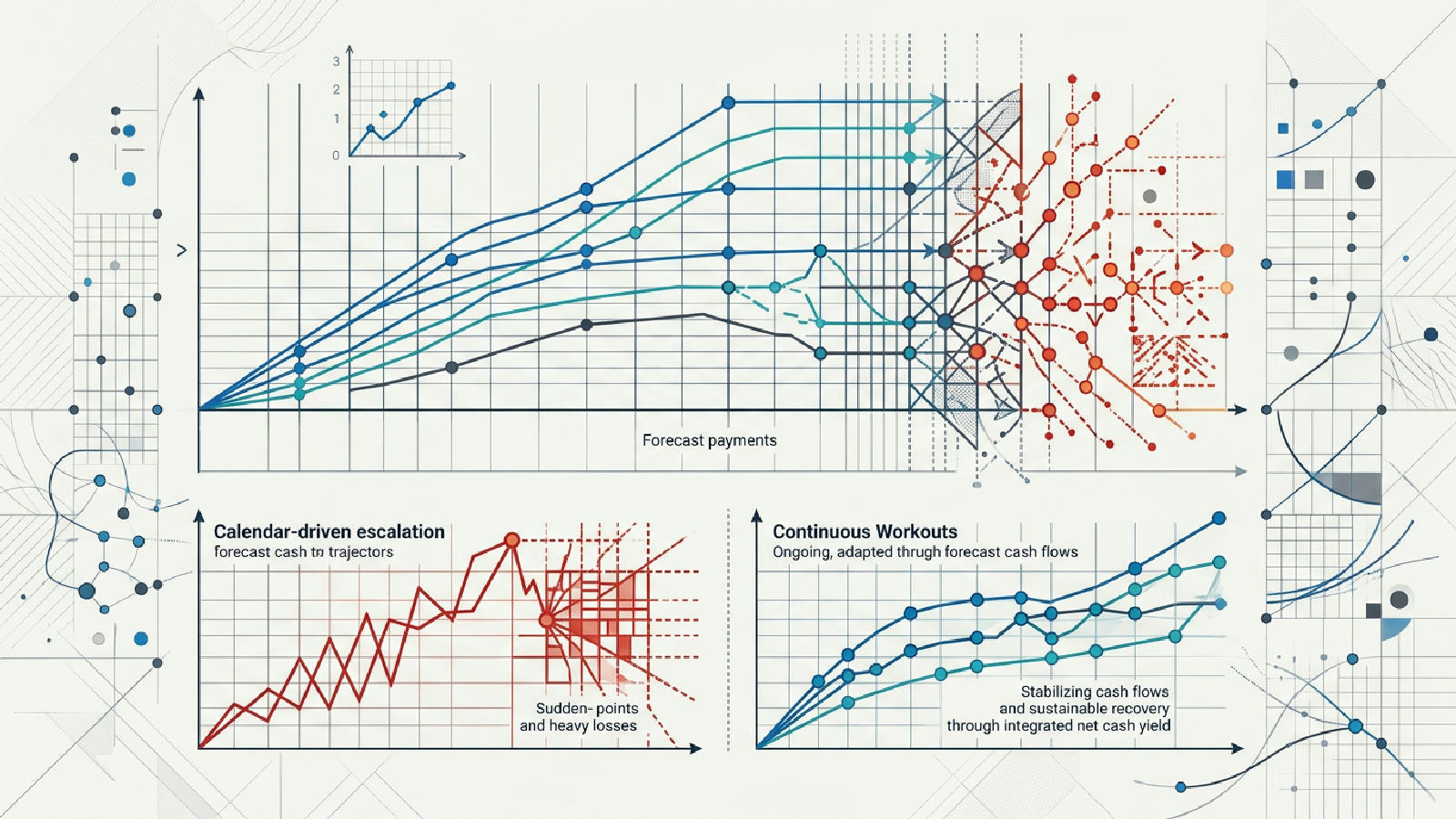
What changes in a borrower's cash generation when an arrears counter moves from day 119 to day 120? The ledger may require a write-off and the funding agreement may demand a sale, but neither establishes whether continued trading will produce more cash than enforcement.
I'd treat that point as a reassessment of the collection strategy, rather than an automatic handover from servicing to litigation or a debt buyer. Continuous workouts leave loss recognition intact while allowing the repayment mechanism to change as evidence about the borrower's capacity changes.
There's no need to manufacture a worsening insolvency cycle to make this argument: company insolvencies in England and Wales fell 15% year on year in October. That doesn't tell us which distressed borrowers remain viable, but it does challenge a recovery strategy built around treating every deterioration as terminal.
For an asset-light SME under wage and debt-service pressure, customer receipts may be the only meaningful source of repayment, particularly where tax arrears are also competing for the same limited cash. Liquidation can extinguish those receipts while insolvency costs and preferential claims, including specified HMRC debts, leave little for ordinary unsecured creditors. I've discussed the separate question of what guarantees actually recover; here, I'm more interested in whether servicing preserves the income needed to honour the debt.
Repayment schedules that respond to trading
A consensual revenue sweep replaces a fixed instalment with an agreed share of eligible receipts, subject to cash buffers and review triggers written into the arrangement. Open Banking can inform that decision, but access to account data doesn't itself authorise a collection; payment initiation or an acquiring split requires its own valid mandate.
Consider an illustrative borrower with £80,000 of impaired principal, £200,000 in monthly receipts, and £6,000 of cash available for debt service after operating costs and current tax obligations, assuming those amounts remain stable. A 5% sweep would collect £10,000 and create a £4,000 shortfall, while even 3% would consume the entire available surplus. Starting at 2% would collect £4,000, leaving £2,000 as headroom.
The percentage needs a review rule because sales and available cash don't move together, particularly when refunds or seasonal stock purchases concentrate outflows. If receipts are diverted or account access fails, collections need an exception process rather than an assumption that yesterday's affordability still holds. A paused mandate has to be visible across collection channels, with duplicate callbacks handled idempotently so that a retry cannot initiate a second debit after the authorised payment has settled.
I'd also separate payment access from creditor priority: taking cash earlier doesn't create security, and distressed payments need review for potential challenge under applicable insolvency law. Keeping a business trading makes sense only while there's credible evidence of viability; fraud or persistent losses can justify a different response.
For a larger B2B exposure, the useful intervention may be a negotiated maturity extension and revised amortisation supported by a short-term cash forecast. Where contracts remain profitable but receipts arrive unevenly, I'd prefer a documented workout before a payment default, with revised terms reflected in the servicing ledger rather than parked in an email. Warrants add little if the business has no credible equity value.
A sale with retained upside offers another route when ownership has to change, provided the economics survive the buyer's collection charges and priority return. An illustrative agreement might pay the seller 60% of residual proceeds after a precisely defined buyer recovery threshold, but that percentage means little without contractual control over allowable collection costs. Nor does retained participation automatically deliver accounting derecognition or satisfy the funding agreement.
The number I'd want beside the collection curve
I'd compare these routes through cumulative net cash recovered per £1 of principal at impairment, reported at 90, 180, and 360 days. The denominator stays fixed even if a loan is sold or reclassified as performing, so an apparent cure can't quietly remove an unsuccessful account from the comparison.
In the illustrative case, nine months of £4,000 collections would produce £36,000 gross, assuming receipts remain stable and the arrangement holds without interruption. If incremental servicing and enforcement costs total £4,000, that's £32,000 net, or 40p per £1 of impaired principal, before discounting and funding costs, with the remaining balance still at risk. An assumed immediate sale at 15p would return £12,000.
Those are scenario inputs, not market benchmarks, and I'd discount the collection path for timing and the probability of failure before comparing it with cash today. A nine-month forecast of 40p isn't evidence that the strategy beats a 15p sale; the realised cohort needs to carry that argument.
Selection is the difficult part: borrowers consenting to data access and variable payments may already be more recoverable than those sent for enforcement. I'd want comparisons within similar risk groups, with failed arrangements included, rather than a favourable average assembled from the accounts that survived long enough to make several payments.
That also changes incentives for whoever handles the account. If a partner earns only a percentage of this month's collections, a sweep that drains payroll cash can look successful until trading stops; a fee model with cohort reviews and responsibility for failed arrangements makes that cost harder to ignore. Bringing the work inside doesn't solve the problem if bonuses reward promises to pay rather than settled cash.
The operational evidence sits beneath that cohort result: agreed payment limits, the forecast used to set them, consent records, and the reasons for each intervention. A credible internal team or servicing partner needs authority to change collections when that evidence changes, without quietly rewriting the exposure's arrears history or the original terms recorded in the system. Otherwise the lender can end up measuring administrative cures while cash performance deteriorates.
For UK and EU portfolios, the same commercial approach still requires local implementation because servicing permissions and insolvency rules don't travel unchanged across borders. I wouldn't treat the EU Credit Servicers Directive as a blanket rule for every fintech loan; scope depends on the credit's origin and the transaction, alongside national implementation.
If nobody can explain why yesterday's sweep was affordable, I wouldn't give much weight to the forecast showing another nine months of collections.